
Japan Etiquette 2026 — Onsen, Trains & Temple Rules
Updated: 2026-08-12
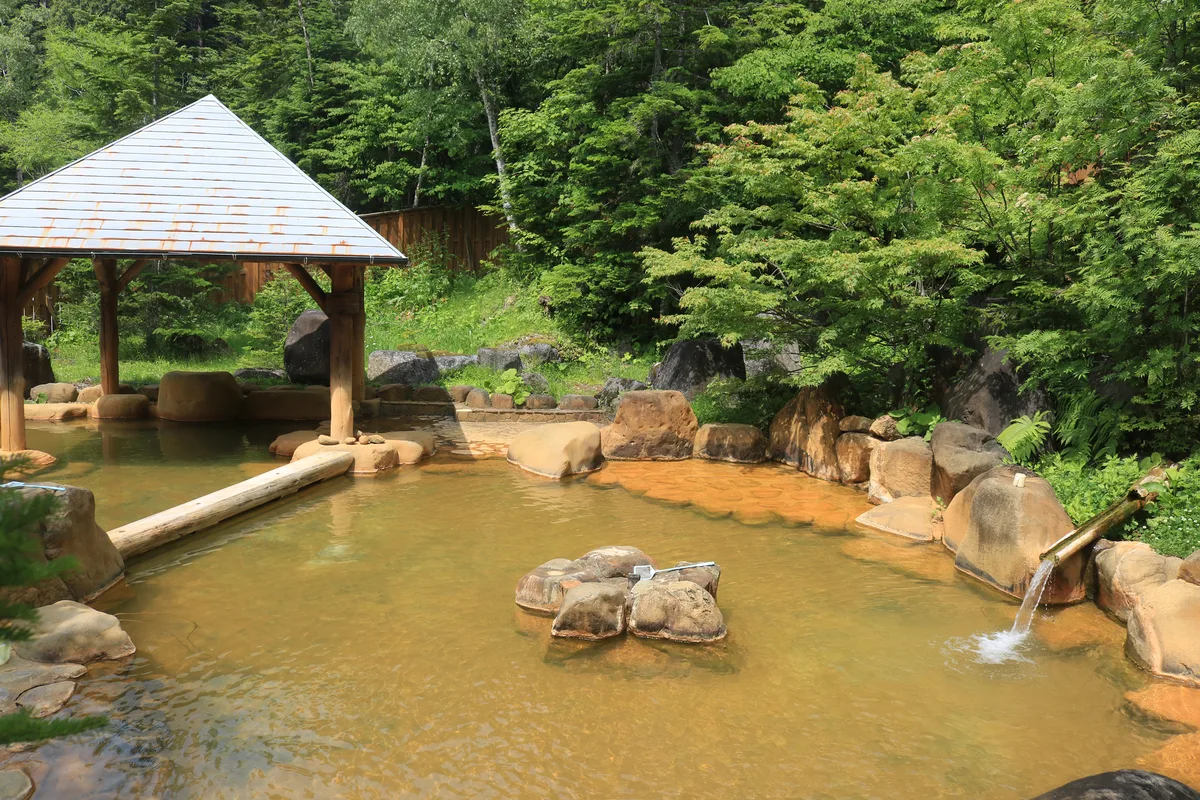
The most common onsen slip-up isn't tattoos — it's bringing your small towel into the bathwater. Wash and rinse fully before you get in, and keep the towel out of the water (fold it on your head or set it aside). As of 2026, roughly half of onsen still turn away visible tattoos, though cover stickers and private baths get around it. Trains and temples have their own rules, covered in the table below.
Onsen, Trains, and Temples: Do's and Don'ts
!Outdoor onsen bath surrounded by nature *Photo: Alpsdake (CC BY-SA 4.0), via Wikimedia Commons*
| Situation | Do | Don't | Why |
|---|---|---|---|
| Onsen | Wash and rinse fully at the shower stations before entering | Bring your towel into the bathwater | The bath is shared, unheated water — it isn't rinsed between guests |
| Onsen (tattoos) | Ask ahead or use a cover sticker if you have small ink | Assume every onsen accepts tattoos | About half of facilities still refuse visible tattoos in 2026 |
| Trains | Keep your phone on silent, step aside from the doors to let riders off first | Take phone calls or eat strong-smelling food in ordinary cars | Quiet-car etiquette is nationwide, not just reserved cars |
| Shrines | Bow at the torii gate, walk to the side of the path, rinse hands at the chozuya | Walk straight down the center of the approach path | The center is reserved for the resident deity |
| Temples | Put your hands together silently before the main hall | Clap your hands like you would at a shrine | Temples (Buddhist) and shrines (Shinto) have different prayer steps |
!Fushimi Inari Taisha torii gate path, Kyoto *Photo: Basile Morin (CC BY-SA 4.0), via Wikimedia Commons*
Onsen — Tattoos, Bathing Order & Towel
- Shower and rinse completely at the wash stations before stepping into the bath — this isn't optional, and staff will call you out if you skip it.
- No swimwear at most traditional onsen; the small towel is for modesty walking around, not for use in the water.
- Tattoo policy varies by facility: hotel-chain onsen (Hilton, Hyatt) and many resort-area baths in Hakone, Nikko, and Kyushu now accept them; independent local sento are more likely to refuse. When in doubt, message ahead, bring a waterproof cover sticker for small ink, or book a private (kashikiri) bath.
Trains — Quiet Cars, Phones & Queuing
!Shinkansen train interior with reserved seating *Photo: OiMax (CC BY 2.0), via Wikimedia Commons*
- Silence your phone and step off to the side rather than blocking the doors when boarding or exiting.
- Phone calls are a firm no in ordinary train cars nationwide, not just designated quiet cars.
- Queue at the marked floor lines for your car number — pushing to board before others exit stands out immediately.
- Priority seats near the doors are marked in a different color — offer them to elderly, pregnant, or disabled riders even if the car looks empty at your stop.
- Eating is generally fine on long-distance trains like the Shinkansen (a bento on a reserved seat is completely normal), but avoid it on short commuter and subway rides.
Temples & Shrines — Prayer Steps & Photos
- Shrine (Shinto): bow once at the torii gate, rinse both hands and your mouth at the chozuya, then at the main hall: offer a coin, bow twice, clap twice, pray, bow once more.
- Temple (Buddhist): put your hands together silently before the main hall — no clapping, that's shrine etiquette only.
- Avoid photographing rituals, priests mid-ceremony, or the offering box up close — a quick check of posted signage tells you what's off-limits.
A guided Kyoto tea ceremony experience is a low-stress way to see proper etiquette modeled for you rather than guessing — self-tracked data shows it from $46.69 (Klook, observed Jul 13, 2026). A Japan eSIM for maps and translation apps on the go runs from $0.49 (KKday, observed Jul 12, 2026) — check the product page for current plan details. - Dress modestly at both — shorts and tank tops are tolerated at major tourist temples but can draw looks at smaller local shrines.
Compare prices for related tickets


FAQ
Can I enter an onsen with tattoos?
It depends on the facility — roughly half of onsen in Japan still turn away visible tattoos as of 2026. Hotel-chain and resort-area baths are more likely to accept them; ask ahead, use a cover sticker, or book a private bath to be safe.
What's the correct onsen bathing order?
Shower and rinse fully at the wash stations first, then enter the bath without your towel — keep it out of the water, folded on your head or set aside.
Are phone calls OK on trains?
No — phone calls are avoided in all train cars across Japan, not just designated quiet cars. Keep your phone on silent and take calls off the train.
What's the etiquette for taking photos at temples?
Photography is generally fine outdoors, but avoid photographing rituals, priests during ceremonies, or close-ups of the offering box. Posted signs will flag any no-photo areas.
Do onsen and temple rules differ much between cities?
The core rules (wash before bathing, bow at torii gates, quiet trains) are nationwide. What varies is tattoo tolerance at onsen and how strict smaller local temples are about dress and photos compared to major tourist sites.
Sources
More guides
- Culture & Etiquette · 2026-08-04Korean Etiquette 2026 — 12 Mistakes Tourists Make
- Culture & Etiquette · 2026-07-30Tipping in Asia: What to Do in All 10 Countries (2026)
- Airports & Transit · 2026-08-12Kansai Airport to Osaka & Kyoto 2026 — Every Option Priced
- Stay Safe & Healthy · 2026-08-11Vietnam Tourist Scams 2026 — Taxi, Money & How to Avoid